Translate

Showing posts with label McRobie Family. Show all posts

Tuesday, March 24, 2020

The Laundress


Barbara McRobie Wilt
I have previously written about Samuel and Sarah Weimer McRobie (“Wanted for Murder”). They had four children, three sons, and one daughter. The daughter, Barbara Ellen McRobie (1870-1949), married John Hanson Wilt (1871-1910) on May 9, 1893; they lived in Garrett County, Maryland.  Between 1895 and 1906, they had seven children. Then, in either 1906 or 1907, Barbara’s life drastically changed—her husband became paralyzed.

According to John Wilt’s obituary, a tree fell on him crushing his spine and paralyzing him from the hips down. I have not been able to find out what John did for a living; but whatever it was, income was no longer coming into the home. Barbara had to go to work. So, she and her then 11-year-old daughter, Susan M. “Susie” Wilt, 1895-1984, took in laundry. And, according to the 1910 U.S. census, she and her daughter were still doing laundry at the time of her husband’s death.
Taking in laundry was probably not an easy decision to make. However, according to the 1940 U.S. census, Barbara only had a sixth-grade education--typical for her time. So, not only were her options limited based on her education, but employment options were also very limited for women at this time.

So, what was life like in the early 1900s compared to today? The average life expectancy for men was 47 years; today, it is 75 years or older. Women only washed their hair once a month usually using Borax or egg yolks; today, some women wash their hair every day with special hair care products. Only six percent of the population had graduated from high school; today, 90 percent of the population has graduated from high school. The average wage was 22 cents per hour; today, the minimum wage is $7.50 per hour. To put the wages in perspective, $1 then is the equivalent to $27.15 today. In terms of purchasing power, it took 63 percent of the hourly wage to buy a dozen eggs; today, it’s about 28 percent.

So, life in the early 1900’s was not easy. And, Barbara and her daughter did not make 22 cents per hour. Generally, a laundress was paid by the number of pieces laundered (and supposedly ironed). And, the means for doing laundry is nowhere as easy as it is today.

Electric washing machines were introduced in America about 1900. However, the machines were primarily made out of wood, with a tub that was rotated by a motor. The motor, which was under the wash tub, was not protected, and water commonly dripped into the motor causing the electricity to short-circuit and cause the user to experience severe shocks. 

Typical 1900-1920's washing machines. Typical woman's dress 1910.
Once the clothes were washed, they had to be wrung out with a hand-cranked wringer. From there, the damp clothes were pinned to a clothes line to dry; and finally, brought in to be ironed. Ironing was no easy task. The irons would have wood handles, they were made of iron, the irons were heavy and usually heated with charcoal contained within the iron itself. Keep in mind this was done while dressed in the typical clothing of women of the early 1900s: floor-length skirts and long sleeves.

Charcoal iron (left), iron heated on stove top; clothers wringer
It was a hard life Barbara had, but hopefully, a good life. Her mother, Sarah, did move in to help her with the children. She managed to make a living and provide for her family.
Barbara is my daughter-in-law’s, Melissa Murphy Oliver, 2nd cousin 4 times removed.

Sources:
1 – Depenweiller, Maria. “The Brief History of Laundry.” OHEA, Ontario Home Economics Association, 22 Apr. 2013, www.ohea.on.ca/blog/the-brief-history-of-laundry.
2 – “Life in 1910.” Inspire More, InspireMore LLC, 2020, www.inspiremore.com/2-crazy-facts-about-life-in-1910-america-that-will-make-you-appreciate-today-a-lot/.
3 - Images other than Barbara Wilt's are from Google Images.

Wednesday, November 20, 2019

Wanted for Murder


Sarah Wiemer McRobie
Sarah Weimer McRobie (1830-1918), my daughter-in-law Melissa Murphy Oliver’s 1st cousin 5 times removed, married Samuel Asbury McRobie (1860-1899) on January 7, 1860, in Garrett County, Maryland. Samuel was one of seven children; Sarah was one of thirteen children. Together they had six children—only three lived to adulthood. Though Sarah was originally from Somerset County, Pennsylvania, she and Samuel, after their marriage, spent the rest of their lives in Maryland.

Fast forward to the Civil War. Samuel enlisted on December 12, 1861, in Oakland, Garrett County, Maryland, as a private in Co. O, 6th Regiment, West Virginia Infantry. He served for the duration of the war and was discharged at the end of his enlistment, December 19, 1864. According to the U.S., Union Soldiers Compiled Service Records, 1861-1865, Samuel was 22 years of age, 6’2” tall, and had fair complexion, grey eyes, and brown hair at the time of his enlistment. Though Company O and others were moved from one location to another as circumstances warranted, the 6th Regiment primarily remained in West Virginia serving as railroad guards and patrolling the railroad lines for the Baltimore & Ohio Railroad. As is to be expected, various detachments of the 6th Regiment, including Company O, found themselves in a variety of skirmishes and battles. However, the action was not just limited to West Virginia; they found themselves, as railroad guards, involved in action also in Pennsylvania and Maryland. 1

Google image
Keep in mind that during the Civil War both Maryland and West Virginia were south of the Mason-Dixon Line.  Culturally, this line is a demarcation between the North and the South. However, “true” Southerners, do not identify Maryland as a Southern state. So, how does this affect Samuel’s story?

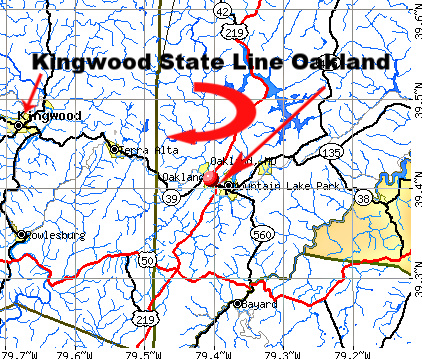
Company O’s main encampment was in Kingwood, West Virginia, not too far from Oakland, Maryland, where Samuel’s wife and family lived. According to available records, Samuel requested a furlough to visit his wife; his request was granted. During the Civil War, it was not unusual for soldiers to not know whether they had actually killed someone; but Samuel McRobie knew differently. Also, it was not unusual for soldiers from both sides of the Civil War to live in the same town. 

Kingwood, WV on left, the State boundary, Oakland, MD on right
While visiting his family, McRobie was “walking down the street and happened to see a Confederate soldier who approached him and a fight pursued.” During the fight between the two soldiers, Samuel began to fear for his life. Apparently, they were in front of a general store as he “removed an ax handle from a small wooden barrel display” and hit the other solder which resulted in killing his opponent. After the fight, Samuel returned to his unit as he had originally planned. However, the sheriff of Oakland was hot on his heels with an arrest warrant for murder.  According to records, when the sheriff came to arrest him., his commanding officer would not turn him over to the sheriff, stating “That is what a Union Soldier would do, Kill Rebs.” Additionally, the sheriff was told that if by any chance the Confederate States succeeded in winning the war, then Private McRobie would be available to arrested.  Obviously, the warrant was never served, and Samuel remained a free man for the rest of his life. 2

Samuel lived out his remaining years on his farm, which today is located beneath the Deep Creek Lake, a resort area near Oakland, Maryland.
Posted on findagrave.com by grampire
Deep Creek Lake - Google image

_______________________
Footnotes: 1.  "Sixth Regiment West Virginia Volunteers United States of America." Harrison County Genealogical Society, http://www.wvhcgs.com.sixthwv.htm
2.  Wilt, R. "A House Divided." Harrison County Genealogical Society, http://www.wvhcgs.com/housedivided.htm