Translate

Showing posts with label Soldiers. Show all posts

Wednesday, November 20, 2019

Wanted for Murder


Sarah Wiemer McRobie
Sarah Weimer McRobie (1830-1918), my daughter-in-law Melissa Murphy Oliver’s 1st cousin 5 times removed, married Samuel Asbury McRobie (1860-1899) on January 7, 1860, in Garrett County, Maryland. Samuel was one of seven children; Sarah was one of thirteen children. Together they had six children—only three lived to adulthood. Though Sarah was originally from Somerset County, Pennsylvania, she and Samuel, after their marriage, spent the rest of their lives in Maryland.

Fast forward to the Civil War. Samuel enlisted on December 12, 1861, in Oakland, Garrett County, Maryland, as a private in Co. O, 6th Regiment, West Virginia Infantry. He served for the duration of the war and was discharged at the end of his enlistment, December 19, 1864. According to the U.S., Union Soldiers Compiled Service Records, 1861-1865, Samuel was 22 years of age, 6’2” tall, and had fair complexion, grey eyes, and brown hair at the time of his enlistment. Though Company O and others were moved from one location to another as circumstances warranted, the 6th Regiment primarily remained in West Virginia serving as railroad guards and patrolling the railroad lines for the Baltimore & Ohio Railroad. As is to be expected, various detachments of the 6th Regiment, including Company O, found themselves in a variety of skirmishes and battles. However, the action was not just limited to West Virginia; they found themselves, as railroad guards, involved in action also in Pennsylvania and Maryland. 1

Google image
Keep in mind that during the Civil War both Maryland and West Virginia were south of the Mason-Dixon Line.  Culturally, this line is a demarcation between the North and the South. However, “true” Southerners, do not identify Maryland as a Southern state. So, how does this affect Samuel’s story?

Company O’s main encampment was in Kingwood, West Virginia, not too far from Oakland, Maryland, where Samuel’s wife and family lived. According to available records, Samuel requested a furlough to visit his wife; his request was granted. During the Civil War, it was not unusual for soldiers to not know whether they had actually killed someone; but Samuel McRobie knew differently. Also, it was not unusual for soldiers from both sides of the Civil War to live in the same town. 
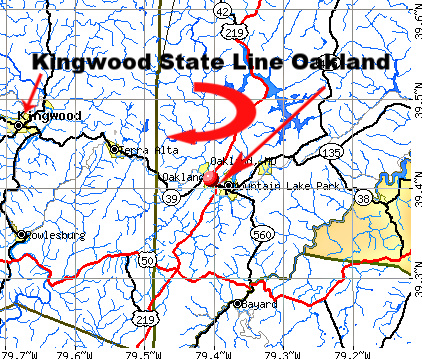
Kingwood, WV on left, the State boundary, Oakland, MD on right
While visiting his family, McRobie was “walking down the street and happened to see a Confederate soldier who approached him and a fight pursued.” During the fight between the two soldiers, Samuel began to fear for his life. Apparently, they were in front of a general store as he “removed an ax handle from a small wooden barrel display” and hit the other solder which resulted in killing his opponent. After the fight, Samuel returned to his unit as he had originally planned. However, the sheriff of Oakland was hot on his heels with an arrest warrant for murder.  According to records, when the sheriff came to arrest him., his commanding officer would not turn him over to the sheriff, stating “That is what a Union Soldier would do, Kill Rebs.” Additionally, the sheriff was told that if by any chance the Confederate States succeeded in winning the war, then Private McRobie would be available to arrested.  Obviously, the warrant was never served, and Samuel remained a free man for the rest of his life. 2

Samuel lived out his remaining years on his farm, which today is located beneath the Deep Creek Lake, a resort area near Oakland, Maryland.
Posted on findagrave.com by grampire
Deep Creek Lake - Google image

_______________________
Footnotes: 1.  "Sixth Regiment West Virginia Volunteers United States of America." Harrison County Genealogical Society, http://www.wvhcgs.com.sixthwv.htm
2.  Wilt, R. "A House Divided." Harrison County Genealogical Society, http://www.wvhcgs.com/housedivided.htm

Monday, July 30, 2018

The Battle of Saratoga and a Great-uncle


Battle of Saratoga - Andy Thomas, Artist - Google Image
John Oliver (1725-1811) is the 7th great-uncle of my sons. He was born in Northern Ireland and immigrated with his parents in 1736 to the Province of Massachusetts Bay. He lived in Athol, Worcester County, Massachusetts; had a wife, Mary L. Beaman (1728-1810); and together, they had 11 children. John was also a Captain of the Massachusetts Militia at the Battle of Saratoga from 19 September 1777 to 17 October 1777 – also known as “The Burgoyne Alarm.”  The Battle of Saratoga is considered by many historians to be a turning point for the Americans during the American Revolution.

John Oliver was one of four captains in Col. Nathan Sparhawk’s 7th Worcester Company of the Massachusetts militia; specifically, captain of the Third Company. John was commissioned a captain on 5 April 1776.  This particular militia was sent to reinforce the American troops “at the time of reduction of General Burgoyne,” the British commander. [1] As a captain, it was John’s responsibility to teach the soldiers how to work together and how to survive on the battlefield. The illustration to the left shows the standard captain insignia for the Continental Army during this war. These would be worn attached to the shoulders of the individual uniform.


Massachusetts Militia

It was not easy being an American soldier at this time. The death rate was high because of battles, espionage, and disease. The British has the best weapons, best commanders, and trained killers. The Americans were barely trained and had few supplies. [2]  However, the Battle of Saratoga changed everything. According to author Dean Snow, showed that “an improvised army of amateurs could take on the best army in the world and force it surrender.” [3] Because of the American success at Saratoga in defeating the British, the French started providing troops and supplies to the Americans. All in all, this win was a boost to the American spirit.

When John Oliver died in 1811, his tombstone was inscribed as follows: Capt. Third Co. Mass./1777 The Burgoyne Alarm ~ John is buried in the Old Pleasant street Cemetery in Athol, Massachusetts.

Photo from Findagrave.com
 
[1] “Participants in the Battle of Saratoga.” Saratoga County NYGenWeb Project – Saratoga County, New York, Heritage Hunters of Saratoga County, 15 Oct. 2015, saratoganygenweb.com/batlo.htm.
[2] “Life of an American Soldier in the Revolutionary War.” Infogram, infogram.com/life-on-an-american-soldier-in-the revolutionary-war.
[3] Snow, Dean. 1777: Tipping Point at Saratoga. 1st ed., Oxford University Press, 2016

Monday, November 6, 2017

Remembering Two Veterans

This Saturday, November 11, is Veterans Day. Veterans Day originated as "Armistice Day" on November 11, 1919, the first anniversary of the end of World War I. Congress passed a resolution in 1926 for an annual observance, and November 11 became a national holiday beginning in 1938. Unlike Memorial Day, Veterans Day pays tribute to all American veterans--living or dead--but especially gives thanks to living veterans who served their country honorably during war or peacetime.

Practically every family has one or more veterans in its family tree: living and dead. My assorted families are no exception; and, I have written about a few of them. In honor of Veterans Day, I decided to highlight two World War II veterans for whom I have pictures and some details about their service: One survived the war; one did not.

R.W. Harriman
Robert W. Harriman, 1921-1944, was from Wisconsin. He served
Henri-Capelle American Cemetery - Google image
with the U.S. Army Air Force, 836th Bomber Squadron and the 487th Heavy Bomber Group as a pilot. He was killed over Germany on December 24, 1944. He is buried in the Henri-Capelle American Cemetery in Liege, Belgium. He was awarded the Distinguished Flying Cross, the Air Medal with two Oak Leaf Clusters, and a Purple Heart.  The Henri-Capelle Cemetery possesses military historic significance as it only holds fallen Americans of two major offensives: first, the U.S. First Army's drive in September 1944 through northern France, Belgium, Holland, and Luxembourg into Germany; and second, the Battle of the Bulge occurring December 1944-January 1945 in Belgium and Luxembourg. Robert is my husband's 3rd cousin 1x removed.

G.S. Oliver
Glenn Stuart Oliver, 1919-2012, was a member of the Minnesota National Guard that was ordered to Federal duty in 1941 as a member of A Company, 194th Tank Battalion. He was stationed in the Philippine Islands when Japan attacked Pearl Harbor. Ten hours later, he lived through the bombing of Clark Air Base on Luzon Island, Philippines. For fourth months he fought with other soldiers to slow Japan's conquest of the Philippines. On April 9, 1942, he became a POW when Bataan was surrendered to the Japanese. He was part of the infamous Bataan Death March. As a POW, he was held at Camp O'Donnell in the Philippines. He, along with other POWs, was selected for transport to Japan in early October 1944. His POW detachment was sent to the Port Area of Manila. [1]

Arisan Maru - Google image
One thousand eight hundred three POWs were boarded onto the Arisan Maru on October 11, 1944. On October 24, 1944, late in the day, the ship was in the Bashi Channel of the South China Sea. The POWs, on deck preparing dinner, watched the Japanese run to the bow of the ship and then to the stern. The ship had been hit by two torpedoes. The POWs were forced back into the holds, and the Japanese covered the hatch openings with their covers: They then abandoned ship. After the Japanese were gone, the POWs climbed onto the deck. Most had survived the attack. For two hours, the ship got lower and lower in the water. Those POWs who could not swim raided the food lockers, as they wanted to die with full stomachs. At some point in time, the ship broke in two. POWs took to the water on anything that floated. Some swam to nearby Japanese ships, but they were pushed away by Japanese sailors with poles. Five men found an abandoned lifeboat with no oars. During the night, they heard the cries for help which faded way until there was silence. Glenn was one of nine men who survived the sinking. Glenn Oliver is the 2nd cousin 2x removed of my children.

As we pause on November 11 to honor all our military veterans, living and dead, it is good to remember the words of Patrick Henry, one of our country's found fathers: "The battle, sir, is not to the strong alone; it is to the vigilant, the active, the brave."

[1] The Battle of Bataan and the 194th Tank Battalion. Minnesota National Guard, www.minnesotanationalguard.org/bataan/The_Battle_of_Bataan_and_the_194th_Tank_Battalion.pdf


Thursday, October 19, 2017

World War I and Two Brothers

Sometimes, when working on a family tree, one comes across an event where you want to know more than just the stated facts. This happened to me with two brothers who both served in France during World War I, were both injured, and one received the Purple Heart. The brothers are Marven Crow (1895-1969) and Clinton Crow (1893-1969). 

On June 5, 1917, Clinton registered for the WWI draft. He was living in Clare, Iowa, and working as a “tiler.” Shortly thereafter, on June 17 1917, Marven also registered for the WWI draft. He, too, was living in Clare, Iowa, and working as a farm hand. [1]

Pvt. Clinton Crowe
By August 1917, Clinton was a Private in Company D, 349th Infantry Regiment – organized at Camp Dodge, Iowa - and was assigned to the 88th Infantry Division. The regiment trained for combat and arrived in France in late 1918. The 349th saw minor combat in Alsace just before the war ended, and the 88th Division as a whole suffered only 78 total casualties. [2] Clinton may or may not have been one of the "counted" casualties: He had , however, been gassed. Patti Knight Sedillo, Clinton's granddaughter, remembers her mother stating that “grandpa had contracted pneumonia after he was gassed and laid in a barn for many days while the weather was very cold and damp.” 

By September 1917, Marvin was a Private in Company M, 90th Division,
Pvt. Marven Clinton
357th Infantry Regiment, 179th Brigade – organized at Camp Travis, Texas. [3] Like Clinton’s regiment, Marven’s also prepared for combat. However, the 375th’s regiment combat experience in France was completely different than that experienced by Clinton’s regiment: Marvin and his fellow soldiers found themselves in the Battle of Saint-Mihiel in northeast France.

The Battle of Saint-Mihiel was a major World War I battle fought from September 12-15, 1918, involving the American Expeditionary Force (AEF) and French troops under the command of General John J. Pershing against German positions. It was the first and only offensive launched solely by the United States Army in World War I, and the attack caught the Germans in the process of retreating. [4]

Marven is the person in the upper right-hand corner.
On September 23, 1918, Marvin received a severe injury during a battle in which the entire rest of his squad perished. This incident happened as a continuation of the Battle of Saint-Mihiel. According to the Stars and Stripes, Marven lost his right arm.  However, they may have meant he had lost the use of his right arm. His discharge papers state the suffered a "shrapnel wound to his right shoulder"; and, at the time of his discharge, he was in "poor" physical condition. The drawing from the Stars and Strips, next to this paragraph, does show his right arm in a sling.

Shadowbox displaying
Marven's WWI mementos

Marvin was awarded the Saint Mihiel Victory Medal (pictured in the upper left-hand corner) for his participation in the Battle of Saint-Mihiel and the Purple Heart Medal for the injuries he suffered. These medals are visible in the pictured shadowbox.

After the war, both men went on to get married, have children, and live successful lives. It is interesting to note that they both died in 1969.


Note: Patti Knight Sedillo, Clinton's granddaughter and Marven's niece, was very helpful as a source for this blog. She provided all the photographs and personal information regarding the brothers. Clinton and Marven are my biological 3rd cousins once removed, and Patti is my 5th cousin.

[1] U.S., World War I Draft Registration Cards, 1917-1918. Ancestry.com, 18 Oct. 2917, http://www.ancestry.com.
[2] "349th Regiment - Lineage and Honors Information." 349th Regiment, 19 Oct. 2017. https://history.army.mil/html/forcestruc/lineages/branches/regt/0349rgt.htm
[3]  Von Roeder, S-Sgt. George. Regimental History of the 357th Infantry. www.90thdivisionassoc.org/90thDivisionFolders/357thbook/357hist.pdf.
[4]  Hanlon, Michael. "The Story of the American Expeditionary Forces: The St. Mihiel Offensive." WORLDWAR1.com, 20 Oct. 2017, http://www.worldwar1.com/dbc/stmihiel.htm.