Translate

Wednesday, January 23, 2019

Patriot Smuggler


 It’s August 24, 1770, and Nathaniel Cary (1727-1797) has just been fined, along with four other men, for being a smuggler by the Boston Committee of Inspection. Nathaniel was born in Boston, Massachusetts, and presumably lived out his life in the Boston area. He died on Nantucket Island, which is off the coast of Cape Cod.


Cary came from a line of merchants, traders, and sea captains. It is not known what he was smuggling, or if he was working in collusion with other gentlemen; however, his activity does take place before the Boston Tea Party of 1773. To deduce what type of activity Cary was involved in, it’s necessary to go back to 1768.

On August 1, 1768, Boston merchants entered into an agreement entitled the “Boston Non-Importation Agreement.” With this agreement, merchants and tradesmen agreed not to import goods from Britain or to export goods to Britain. And though this was not the first step of rebellion against British rule, it was just one of many. This agreement boycotted goods being taxed by Britain:  lead, glass, linen and other high-quality cloth, oil, paint, paper, and tea – just to name a few. The goods being taxed were goods the Colonies themselves did not produced or make.

It was very tempting for Colonists to turn to smuggling:  It was a way to obtain wanted goods, but also undermine British regulations.

The Boston Chronicle newspaper constantly published names of those who were caught “importing”
forbidden goods, the names of their business, and the ships on which the goods arrived. An admonition was also published to not patronize the accused smugglers.

So, back to Nathaniel. As he was fined for disobeying the non-importation agreement, it can be safely assumed he was a merchant. And as a merchant, he would try to serve his clientele in providing them  goods not easily obtained. Yes, he worked outside of the local law; but, in the plus column, he was not a Loyalist who defected to Canada or to England at the time of the Revolution.

Nathaniel Cary is not one of the known members of the Boston Tea Party in 1773. But as he was a native Bostonian, perhaps he gave he them assistance in some way.

So, can a smuggler also be a patriot? I believe so.

Nathaniel Cary is my sons 3rd cousin 8x removed.

Image from Findagrave.com


Note: Unless otherwise noted, all images are from Google.com

Wednesday, November 28, 2018

Colonial Post Rider


Edward Adams (1739-1825), born in Milton, Massachusetts, was a Colonial post rider who carried
the Continental mail between Boston and Hartford, Massachusetts – a distance of 102 miles. Though he did serve briefly during the American Revolution in 1776, his primary occupation was as a mail carrier. Edward was a post rider for 16 years before the Revolutionary War and continued as a post rider throughout the Revolutionary War.
Edward's route went from Boston to Hartford and back.
Edward married Dorothy Spear (1743-1802) on June 30, 1763. They had nine children – all of whom lived to adulthood. After Dorothy died in 1802, Edward married Sarah Morey (1762-1851) on February 15, 1810.

Generally speaking, a post rider was a contractor who promised to deliver the mail within a certain geographical area for a set period of time. The mail was not delivered to individuals as we have today; the mail was delivered to a central location in town – a general store, an inn, a tavern. The townspeople would have to come to the central location to get their mail. If someone was picking up mail for themselves and there was mail for neighbors, they would also take their neighbors’ mail and deliver the mail to them. And, it was not the sender, but the receiver who had to pay the postage. 

Mail delivery, as part of Colonial America, started officially in 1775. The Colonists established the postal system, i.e., post riders, as a way to rebel against the what they saw as the unfair rules as established by the Royal Mail Service. Benjamin Franklin was the first postmaster. In fact, he was also the postmaster during the Royal Mail Service. Franklin required the post riders to ride day and night using relays, carrying a lantern at night to light their way.

The post riders did not have an easy job. Much of the area was wilderness. Travel required fresh horses, overnight stays, hardships due to weather, threats from attacks by Indians, and robbery by highwaymen. And, should the post riders manage to escape these hazards of the job, the sender of the mail could not be certain that the letter would arrive safely. [1] A letter could take as long as two weeks to make the 100 plus miles between two cities.

Before being eliminated by the advent of the Pony Express and railroads, the post riders provided the longest and most complete service.

Edward Adams is the 3rd cousin 8 times removed of my sons.
___________________________
1 – Gavin, Alison M. “In the King’s Service: Hugh Finlay and the Postal System in Colonial America.” National Archives, Summer 2009, www.archives.gov/publications/prologue//2009/ summer/finaly.html. Vol. 41, No. 2.

Tuesday, November 20, 2018

Five Sons Scalped


Typical Way Station - Google Image
By 1785, George H. Noaks (1736-1789) and his wife Diana Ditto Noaks (1739- ?) had ten children.  On January 1, 1785, five of those children – all sons – were killed and scalped and a daughter was wounded by a raiding party of Shawnee and Cherokee Indians at Crab Orchard. The boys ranged from 5 to 20 years of age, the daughter was 12 years old.

Before the Revolutionary War, the Nokes/Noaks/Noakes families are found in Maryland, North Carolina, and Virginia. George and Diana Noaks were married in Maryland in 1755 and moved to North Carolina.  In 1781, they moved to Kentucky where they settled a few miles southeast of Crab Orchard. Their “settlement” was called Noaks Station – a small-sized “station” of only a few cabins without a defensive block house like the one in Crab Orchard.  The larger settlements (way stations) were built for protection. Because of the dangerous travel westward, the larger way stations were built for protection and would have log blockhouses for defense.

As travelers reached the various way stations, whether defensive or non-defensive, some decided to stay. Perhaps they were tired of traveling. Perhaps they were tired of facing the dangers of the “road”: robbers, criminals, Indians. Whatever the reason, travelers stayed and constructed homes. The Noaks were one of those families.
 
Wilderness Trail and Logan's Trace - Google Image
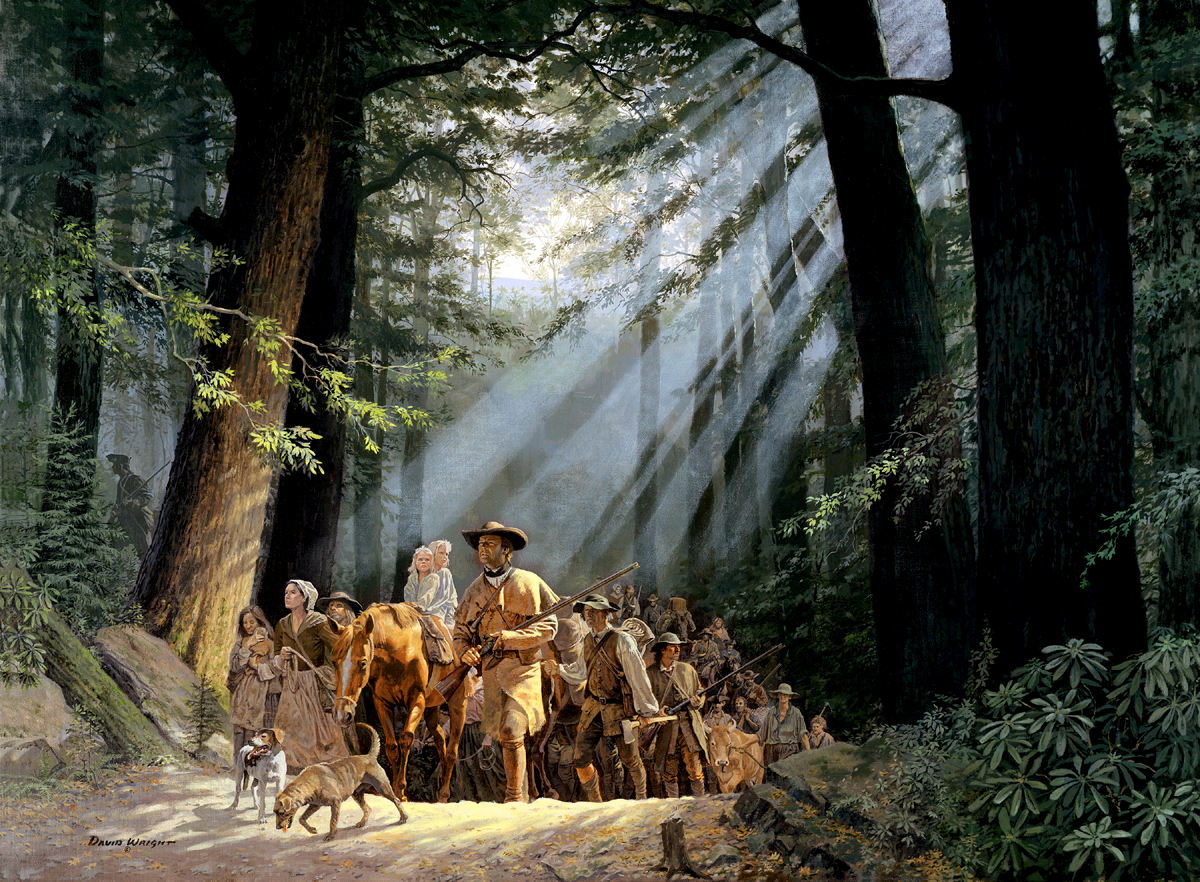
Crab Orchard and Noaks Station were near the end of “Logan Trace,” a part of the “Wilderness Road” established by Daniel Boone. The “road” started in Virginia, went south to Tennessee, and then turned north to go through the Cumberland Gap and Kentucky. The Logan Trace was named after Colonel Benjamin Logan, a friend of Boone’s who came to the mountains with him in 1775. Logan’s Trace was a branch of the Wilderness Road; but instead of going north, it veered northwestward.
 
A part of the Wilderness Trail today - Google Images

The settlers at the various way stations were subjected to multi-tribal raiding parties. The most troublesome for the settlers were the Indian raids coming out of the north from Ohio—the Shawnee, Mingo, Delaware, Wyandot, and Miami tribes. In general, Indian tribes were resentful of the takeover of their hunting lands. 
 
Daniel Boone leading travelers through the Cumberland Gap - Cumberland Gap Historical Park
The conflict between settlers and Indians continued well into the 1790s. There were ambushes, captures, horse stealing, murders, and raids. In 1785, about 100 travelers were killed while on the Wilderness Road. Because Noaks Station was “non-defensive,” George, Diana, and their children were easy targets. So unfortunately, in 1789, the Noaks family found themselves the target of a raid.

An interesting note: The name Noaks and its various spellings means "near the oaks." George and Diana Ditto Noaks are my biological 5th great-grandparents.
 
Sources: Material for this particular blog comes a variety of documents found on Ancestry.com.