Translate

Wednesday, January 29, 2020

A Trap Door Saved His House


I have previously written about King Philip’s War (1675-1678); and, since that time, I found other family members whose life was touched by that same war:  Samuel Morse (1639-1717) and Joseph Allen (1652-1704), my husband’s 8th great-uncle and 6th great grandfather, respectively.

King Philip - Google Images
Metacom, the Wampanoag Indian Chief, was also known as “King Philip.” In the 1600s (and today), the Wampanoag Indians, lived on the East Coast—primarily in Massachusetts and Rhode Island. The Wampanoag Indians and the colonists had maintained a somewhat peaceful relationship. However, this “peaceful co-existence” did not continue once Metacom became the chief of the Wampanoag tribe. 

In its simplest form, King Philip’s War occurred because of violations—by both sides—of various peace treaties. These violations served to increase tension between the two parties. Additionally, a 1671 treaty required the Indians to surrender their firearms. Obviously, the Wampanoags would not want this provision. And, I can only imagine that Wampanoags did not turn in those firearms. Additionally, the tensions flared dramatically when three Indians were hanged for murder in the Plymouth Colony.  (I do wonder if they were rightly accused; and if they were, did they use those firearms which they were not to have.) The Indians retaliated by raiding villages, and the colonists in turn attacked and burned Indian villages:  This became a vicious cycle.  These activities lead up to February 21, 1676, in Medfield, Massachusetts. February 21, 1676, is considered to be the actual start of King Philip’s war. 
Location of Medfield, Mass. (green star)
 
The residents of Medfield, Massachusetts, had been hearing horror stories of towns in New England being burned to the ground and the residents of those towns being killed and scalped. So, the colonial residents would either spend their nights in local garrisons (also known as palisades) or sleeping with their firearms. However, the Medfield residents had become complacent as the Massachusetts Governor had stationed over 70 soldiers in the town and at least 75 of the men in town were armed. 

Setting fire to Colonist home - Google Images
Early in the morning of February 21, Samuel Morse went to his barn and discovered an Indian hiding under the hay. Morse fled with his family as the Indian set fire to Morse’s barn and home. This was the signal for the rest of the Indians, who were hiding under bushes and fences and behind barns, to torch Medfield. The Indians were well-armed with weapons, ammunition, and combustible materials. In the end, over 32 homes, two mills, multiple barns, and several miscellaneous buildings were destroyed; 17 settlers (including at least three children) and 3 soldiers were dead along with an unknown number of Native Americans, and at least one child was taken hostage; and horses and livestock were burned alive. So, how does Joseph Allen fit into all of this?

Joseph Allen’s home was the only house in the north end of town to survive the attack. When the Allen’s received word of the attack, the family fled to the town garrison, leaving behind – and unprotected – their homestead.

Colonial Cooper - Google Images
Joseph was a cooper. A cooper builds and repairs barrels and crates. In his workshop, Joseph had a lot of wood shavings. The Indians used these shavings by piling them up in the house and setting them on fire. However, they did not pay attention to where they were lighting the fire: on top of a trap door. As the trap door caught fire, it fell through into the dirt basement, and the fire went out. The homestead was saved because the fire was set in the wrong location. 

Though Joseph Allen is just a footnote in history; he has become famous because of the way his house was not destroyed.

Joseph Allen house as it looks today

Resources used:

--DeSorgher, Richard. Uniquely Medfield: “Once Upon a Town: Medfield Under Attack.” 28 Sept. 2012, https://patch.com/massachusetts/medfield/uniquely=medfield-once-upon-a-town-medfield-under-attack.
--DeSorgher, Richard. “While Hawaii Will Note Pearl Harbor and NYC Will Always Remember 9/11, Medfield Will Never Forget the Events of Feb. 21, 1676.” Neighbor News, 17 Feb. 2012, https://patch.com/massachusetts/medfield/desorgher-uniquely-medfield.
--“King Philip War.” Millis History. http://www.millishistory.org/king-phillip-trees.html.
--King Philip’s War: Burning of Medfield. https://www.arcgis.com/home.

Thursday, January 16, 2020

Almost Burned at the Stake


In a prior blog entitled The First White Settlers in Tennessee, I noted that my 6th great-grandparents William Bean’s (1721-1782) and Lydia “Liddy” Russell Bean’s (1726-1788) lives had been thoroughly documented as the first white settlers in Tennessee. The previous blog was about William. This time, I am going to tell you about Lydia.

Lydia was born in Pennsylvania, married William in 1740 in Virginia, and was the mother of 12 children. In 1764 Lydia and William moved from Virginia to South Carolina; and then, in 1769, moved to what is known today as Tennessee, settling in the Watauga settlement.

County where Watauga settlement was located
As is usual with the westward migration of settlers, the native Indians were less than welcoming to those encroaching onto their territory. The Native American tribe in the Watauga settlement area was Cherokee whose chief was called “Old Abraham.” In 1769, the Cherokee attacked the Watauga settlement. However, prior to the attack, most of the local settlers had made it to the safe confines of Ft. Watauga – all thanks to being forewarned by Nancy Ward, a Cherokee, also known as “Beloved Woman of the Cherokees”:  The title designated her high status within the tribe.

Typical settlers' fort
Nancy Ward
Instead of immediately seeking shelter at the fort, Lydia decided to try to save her cattle and taking the risk of driving them to the fort. However, the Cherokee raiders caught up with her and a fellow settler, Samuel Moore (who had not gotten to the fort in time). Outside of the walls of the fort, Moore, was burned to death. The warriors then retreated to their village of Echota with Lydia in tow. Their plan was to burn Lydia Russell at the stake. However, Nancy Ward, who happened to be at the village, As one source states, “Suddenly Nancy Ward pushed through the crowd and scattered the burning brands with her bare hands. She announced that while she served as Beloved Woman, no white captive would be burned in the peace town of Echota.” Nancy took in Lydia and nursed her back to health from the injuries Lydia had received. 
saved her from that fate.

Lydia ended up staying at the Indian village for over a month. While there, Lydia taught the women how to set up a loom, spin yarn, and weave cloth. The woven cloth that Lydia introduced to them was far superior to what they had been using. The tribe, at this point in time, had been wearing traditional hide clothing and rough hemp clothing bought from traders. 

During this period of time, Nancy and Lydia developed a strong friendship. After her release, Lydia would return to the village with her dairy cattle in order to teach Nancy and the other women of the Indian village how to prepare and use dairy products.

Lydia and Nancy helped to change the relationship between the settlers and the Indians. However, they alone could not stop the Indian raids. Lydia’s brother George Russell (1720-1796) was killed by Indians while on a hunting trip in Grainger County, Tennessee, in 1796 (the same year she was captured by the Indians); and her daughter Jane Bean (1766-1799) was killed and scalped in 1798, while working outside on her loom.

Lydia Russell Bean is my 6th great-grandmother; her brother George Bean is my 7th great-uncle; and her daughter Jane Bean is my 6th great-aunt.
Location of Ft. Watauga/Settlement

Wednesday, November 20, 2019

Wanted for Murder


Sarah Wiemer McRobie
Sarah Weimer McRobie (1830-1918), my daughter-in-law Melissa Murphy Oliver’s 1st cousin 5 times removed, married Samuel Asbury McRobie (1860-1899) on January 7, 1860, in Garrett County, Maryland. Samuel was one of seven children; Sarah was one of thirteen children. Together they had six children—only three lived to adulthood. Though Sarah was originally from Somerset County, Pennsylvania, she and Samuel, after their marriage, spent the rest of their lives in Maryland.

Fast forward to the Civil War. Samuel enlisted on December 12, 1861, in Oakland, Garrett County, Maryland, as a private in Co. O, 6th Regiment, West Virginia Infantry. He served for the duration of the war and was discharged at the end of his enlistment, December 19, 1864. According to the U.S., Union Soldiers Compiled Service Records, 1861-1865, Samuel was 22 years of age, 6’2” tall, and had fair complexion, grey eyes, and brown hair at the time of his enlistment. Though Company O and others were moved from one location to another as circumstances warranted, the 6th Regiment primarily remained in West Virginia serving as railroad guards and patrolling the railroad lines for the Baltimore & Ohio Railroad. As is to be expected, various detachments of the 6th Regiment, including Company O, found themselves in a variety of skirmishes and battles. However, the action was not just limited to West Virginia; they found themselves, as railroad guards, involved in action also in Pennsylvania and Maryland. 1

Google image
Keep in mind that during the Civil War both Maryland and West Virginia were south of the Mason-Dixon Line.  Culturally, this line is a demarcation between the North and the South. However, “true” Southerners, do not identify Maryland as a Southern state. So, how does this affect Samuel’s story?

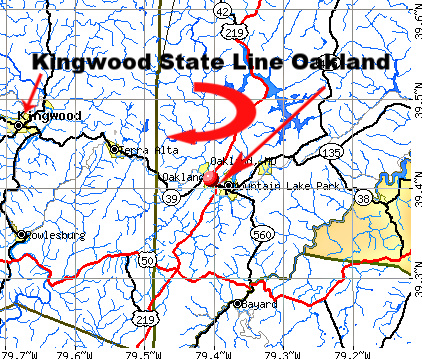
Company O’s main encampment was in Kingwood, West Virginia, not too far from Oakland, Maryland, where Samuel’s wife and family lived. According to available records, Samuel requested a furlough to visit his wife; his request was granted. During the Civil War, it was not unusual for soldiers to not know whether they had actually killed someone; but Samuel McRobie knew differently. Also, it was not unusual for soldiers from both sides of the Civil War to live in the same town. 

Kingwood, WV on left, the State boundary, Oakland, MD on right
While visiting his family, McRobie was “walking down the street and happened to see a Confederate soldier who approached him and a fight pursued.” During the fight between the two soldiers, Samuel began to fear for his life. Apparently, they were in front of a general store as he “removed an ax handle from a small wooden barrel display” and hit the other solder which resulted in killing his opponent. After the fight, Samuel returned to his unit as he had originally planned. However, the sheriff of Oakland was hot on his heels with an arrest warrant for murder.  According to records, when the sheriff came to arrest him., his commanding officer would not turn him over to the sheriff, stating “That is what a Union Soldier would do, Kill Rebs.” Additionally, the sheriff was told that if by any chance the Confederate States succeeded in winning the war, then Private McRobie would be available to arrested.  Obviously, the warrant was never served, and Samuel remained a free man for the rest of his life. 2

Samuel lived out his remaining years on his farm, which today is located beneath the Deep Creek Lake, a resort area near Oakland, Maryland.
Posted on findagrave.com by grampire
Deep Creek Lake - Google image

_______________________
Footnotes: 1.  "Sixth Regiment West Virginia Volunteers United States of America." Harrison County Genealogical Society, http://www.wvhcgs.com.sixthwv.htm
2.  Wilt, R. "A House Divided." Harrison County Genealogical Society, http://www.wvhcgs.com/housedivided.htm